- Welcome to Pacific Bridge Capital
- Tel: 024.3516.1111
- Fax: 024.3684.1111
- info@pacificcapital.vn

Vietnam stocks fell the most in Asia at the beginning of the week

Big profits, how do banks and securities companies contribute to the state budget?
14/09/2022
Heart Hospital shares suddenly hit the ceiling on the day the stock market fell deeply
19/09/2022The decrease of 2.32% made Vietnam the largest market in Asia on September 19. The corresponding market capitalization was “blown away” by nearly VND 114,000 billion (~ USD 5 billion).
The stock market has just experienced another “black Monday” with red covering most of the stock groups. VN-Index closed down 28.6 points (-2.32%) to 1,205.43 points with the matched price reaching nearly 14,900 billion dong. This decrease has made Vietnam the largest market that fell in Asia today. The corresponding market capitalization was “blown away” by nearly 114,000 billion VND (~5 billion USD) to approximately 4.8 million billion VND.
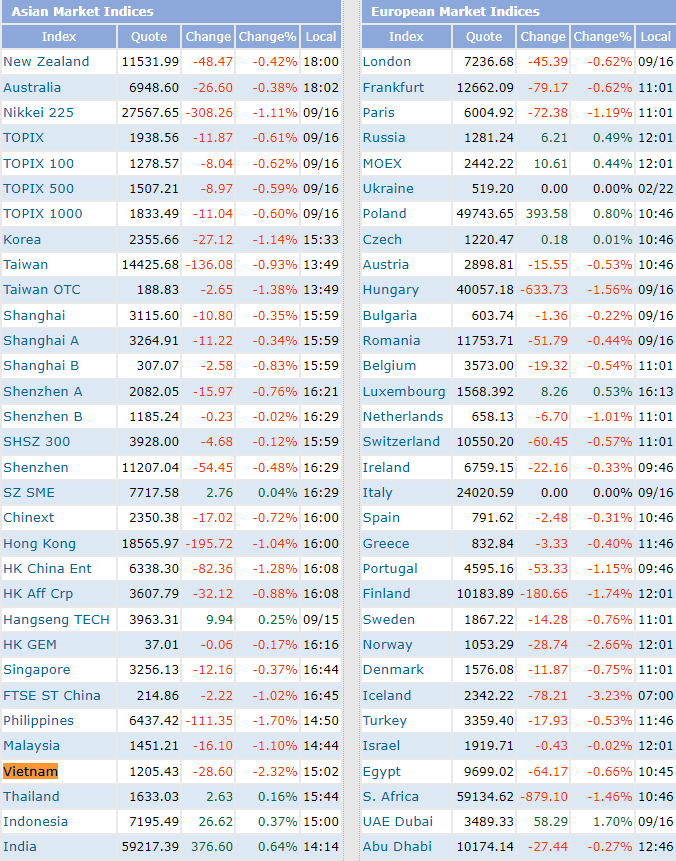
The liquidity almost did not improve in the last session, which is a clear proof for the cautious sentiment of investors. Usually in the volatile market sessions, especially in the downward direction, the trading is much more active. However, unpredictable fluctuations in the global financial market have made investors prefer to stay out of sight instead of bottoming out during this period.
In the face of inflationary pressure, investors are increasingly worried that the Fed will push the economy into a recession as it continues to aggressively raise interest rates. According to CME Group data, investors have completely abandoned the option of increasing 0.5 percentage points after the August inflation report, instead assessing there is a 20% chance that the Fed will raise interest rates by more than 1%. The fact that the Fed continues to accelerate the attraction of money will strongly affect capital flows into high-risk financial assets such as securities and the Vietnamese market is no exception.
On the other hand, the recent sharp drop made the valuation of cheap Vietnamese securities even cheaper. According to data from Algo Platform, VN-Index is trading at a P/E of 13.07 times, significantly lower than the 10-year average (15.1 times). The VN-Index’s forward 2022 P/E, according to Mirae Asset’s calculations, is still low compared to other countries in the world in the context that the market is expected to have an EPS growth rate of nearly 29% in 2022. This shows that Vietnam’s stock market is currently trading at a relatively cheap valuation compared to its future growth potential.
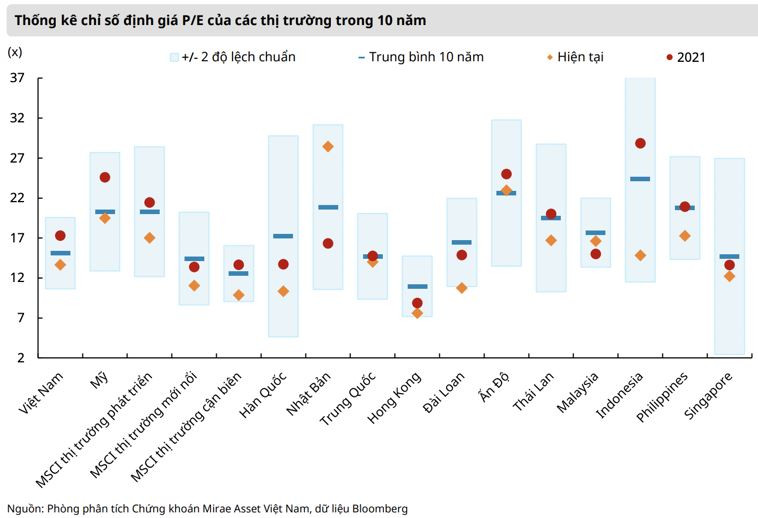
In the same opinion, Dragon Capital believes that Vietnamese stocks are at an attractive valuation with a forward P/E of 10 times and EPS growth of 17%. Although growth is likely to decelerate next year, it will only be a slowdown, not negative growth. This foreign fund assesses that the Vietnamese market has the prospect of outstanding returns in the emerging markets while the risk is lower thanks to the stable macro internals.
Vietnam’s position is inevitably affected by global instability, but the domestic economy is still operating well and is highly appreciated by many international organizations. After S&P raised its credit rating to BB+, Vietnam continued to be upgraded by Moody’s to Ba2 with a stable long-term outlook. In the same opinion, Dragon Capital forecasts that Vietnam’s GDP growth can reach double digits in the third quarter and 7.8% in 2022.
The impact from external factors on Vietnam’s economy, according to Dragon Capital, is much lower than that of emerging countries and is not systematic. Besides, Vietnam is not in the group of countries affected by the consequences of improper policies. Therefore, Dragon Capital believes that the market will hold the 1,200 point mark.
Ha Linh/Market Lifestyle