- Welcome to Pacific Bridge Capital
- Tel: 024.3516.1111
- Fax: 024.3684.1111
- info@pacificcapital.vn

Global capital flows strongly into the US market, what factors will help foreign investors return to Vietnam in 2025?

VSDC General Director informs about the process of upgrading the stock market
06/12/2024
Session 12/12: Foreign investors continued to net sell more than 300 billion VND, “dumping” a Bluechip stock
12/12/2024Trading from both active funds and ETFs is heavily biased towards net withdrawals from emerging markets and the outlook for December is not too promising as the US market is still attracting most of the attention.
Money flows strongly into the US market
In its global investment cash flow report, SSI Research assessed that global equity funds were clearly differentiated as the net inflow trend continued strongly in November, with a total value of 136 billion USD – the highest disbursement level since March 2021.
However, cash flows were divergent, focusing mainly on the US market while other major markets recorded net withdrawals (except Japan). The US presidential election results with Mr. Trump’s overwhelming victory helped to ease concerns and helped cash flows into risky assets break out.
In November, capital flows into developed markets surged (+144 billion USD) while emerging markets were net outflows (-8 billion USD). Capital flows into developed market (DM) equity funds surged and were net inflows of 144 billion USD. In total, 11 months saw capital flows disbursement of 506 billion USD into developed market funds, with the US market continuing to attract capital flows (+143 billion USD and 448 billion USD for 11 months).
The technology group continues to attract the majority of cash flow thanks to the push from individual investors, while investment funds are also more active in disbursing into the US market, with survey results from BofA showing that the allocation ratio to the US stock market has reached its highest level in the past 11 years.
Meanwhile, capital flows into emerging market (EM) stocks reversed to net outflows. A stronger US dollar, concerns about tariff policies and the psychological impact of China’s economic stimulus package cooled down, causing strong net capital outflows in November, with a value of up to 8 billion USD – the highest net outflow since June 2020. Most markets recorded negative results such as China (-4 billion USD), India (659 million USD).
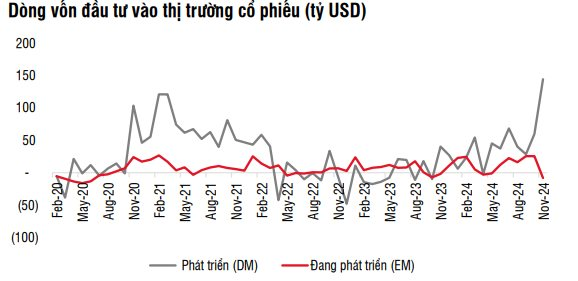
The appeal to the US market is expected to remain at least in December, as 1) equity market volatility is generally lower in December and companies are also implementing their share buyback programs as committed) and 2) money flows shift from money funds to equity funds as the Fed continues its rate-cutting path. Money flows to emerging markets will be relatively divergent, depending on the impact of President D. Trump’s upcoming policies.
Factors that can attract foreign capital back to Vietnam in 2025
In Vietnam, SSI Research believes that the intensity of net withdrawals has increased. ETFs accelerated capital withdrawals in November after two months of slowing down, with a total value of up to VND1.48 trillion, compared to VND700 billion in September and VND300 billion in October. This is the 11th consecutive month of net withdrawals this year, bringing the net withdrawal value from the beginning of the year to -22.78 trillion VND, equivalent to -30% of total assets by the end of 2023, bringing the total assets of ETFs to VND56.5 trillion.
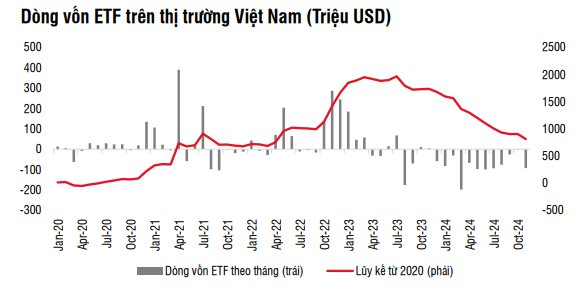
Capital withdrawal pressure increased sharply in the group of US and European funds, typically the VanEck fund (642 billion) and the Xtrackers FTSE Vietnam ETF fund (214 billion), similar to the context of strong cash withdrawal in developing markets. In addition, domestic funds such as DCVFM VN30, DCVFM VNDiamond and MAFM VNDIAMOND ETF also reversed net withdrawals this month with values of 301 billion, 204 billion and 82 billion VND respectively.
In contrast, Fubon fund traded more actively after 6 consecutive months of strong selling, with net withdrawal value decreasing significantly to -28 billion in November. SSIAM VNFIN Lead fund recorded a slight net inflow reversal of +16 billion VND after 8 consecutive months of net withdrawal. KIM Growth VN30 (+34 billion) was the only fund that maintained positive inflows for many months.
More positive signals from Fubon fund – the ETF fund with the largest total assets in the Vietnamese market in the second half of November or the Ministry of Finance is amending Decree 155 with a draft allowing securities companies to register as market makers of ETF certificates to help create liquidity for domestic ETF funds, opening up more opportunities for newly listed ETF funds on the market.
Active funds had relatively differentiated transactions in November. While active funds investing only in Vietnam narrowed their net withdrawal to only about 500 billion, multinational investment funds maintained strong net withdrawals (about 1.2 trillion VND), bringing the total net withdrawal from active funds in November to 1.7 trillion VND.
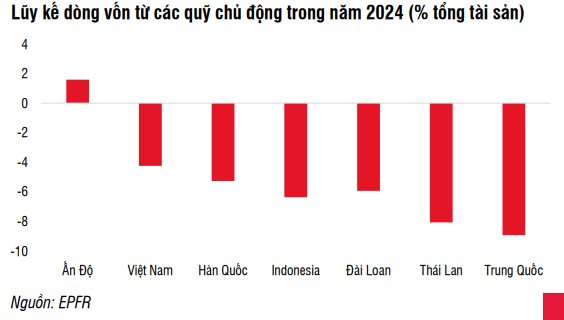
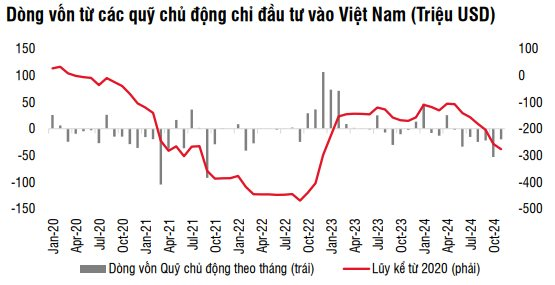
Trading from both active funds and ETFs is heavily biased towards net withdrawals from emerging markets and the outlook for December is not too promising as the US market is still attracting most of the attention.
However, SSI Research believes that the positive results after 1 month of implementing the regulation allowing foreign institutional investors to trade and buy stocks without requiring sufficient funds (Non Pre-funding solution – NPS) and FTSE Russell’s positive assessments of this product will be factors that can attract foreign capital flows back to Vietnam in 2025 when the capital flows shift to developing markets.
Never Who/Market Pulse