- Welcome to Pacific Bridge Capital
- Tel: 024.3516.1111
- Fax: 024.3684.1111
- info@pacificcapital.vn

Liquidity is continuously “losing”, why is the margin balance still increasing in the third quarter?

Portrait of the “factors” that caused VN-Index to lose 1,000 points, HoSE market capitalization flew by VND 134,000 billion in the session of October 24
24/10/2022
International aviation is forecasted to grow strongly in 2023, aviation stocks are about to “take off”?
26/10/2022The margin lending channel of securities companies currently plays a role in balancing the source for tightening the bond market and running out of credit room.
The stock market is going through a turbulent period with rapid and deep declines, even, the VN-Index also has times to break the 1,000 point mark, equivalent to a decrease of about 35% compared to the peak set in early April. .
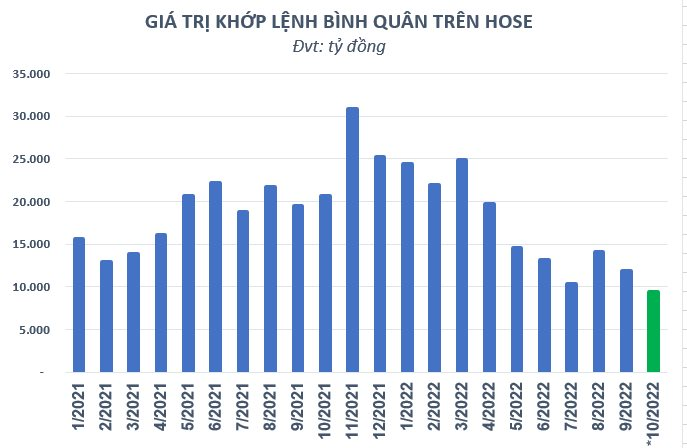
Along with the deep drop of the index, the depressed sentiment caused market liquidity to “lose” with the trading value down to a record low. The average matching transaction value on HOSE since the beginning of October until now is only approximately 9,400 billion dong, even there was a session when the liquidity dropped to an extremely low level in the past 2 years.
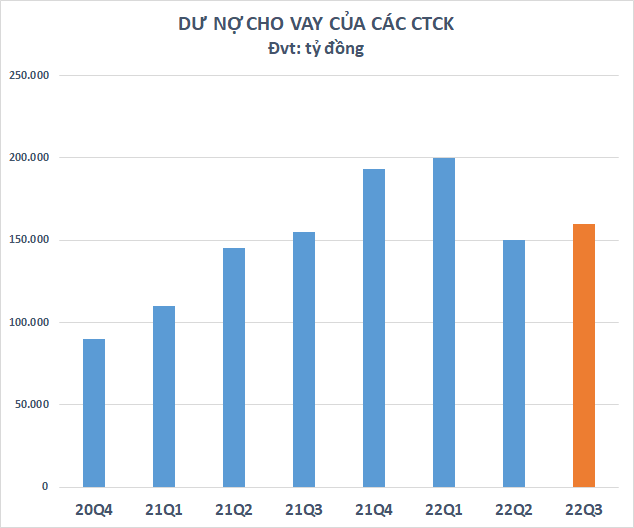
In light of the market’s gloomy movements, it was quite surprising that the market’s loan balance increased again in the third quarter after a sharp decline in the previous quarter.
According to estimates, outstanding loans of securities companies by the end of the third quarter of 2022 were about VND 165,000 billion (~$6.8 billion), a slight increase of about 15,000 billion compared to the previous quarter. Out of 165,000 billion dong of outstanding loans, it is estimated that about 155,000 billion dong is margin loans, the rest is pre-sale.
The question now is why the market fell but the margin loan balance still increased?
In this regard, many views believe that the cause may be due to the recovery spans of VN-Index since the beginning of the third quarter, which has triggered the cash flow to borrow margin to catch the bottom of stocks. Especially, after the wave of “call margin” took place on a large scale at the end of the second quarter, many investors’ accounts have reached the safe threshold.
However, in the opinion of Mr. Bui Van Huy – Director of DSC Securities Branch, the margin balance of “small” individual investors decreased by 15-20% in the third quarter . Currently, any investors who have been forced to sell have been sold out in the mid-October period, because with the mentality of “birds are afraid of bent branches”, few dare to take the risk of using leverage when the market is as volatile as it is now.
As for the remaining investors, if they still “clamp” the margin, they will surely lose quite heavily. Therefore, Mr. Huy believes that retail investors currently have low leverage and margin risk in this group is not high.
So why is the margin balance still increasing? Mr. Huy said that the margin lending channel of securities companies currently plays a role in balancing the source for tightening the bond market and running out of credit room . When lending sources are tightened, there are many cases where business leaders and large shareholders can borrow margin loans from securities companies.
With the forecast that the outstanding loans of retail investors will decrease, Mr. Huy estimates that ~20 trillion margin will be increased due to large shareholder/business leader deals in the third quarter. Currently, the source of cash There are still quite a lot of securities companies, the trend of margin lending at securities companies may still continue in the fourth quarter.
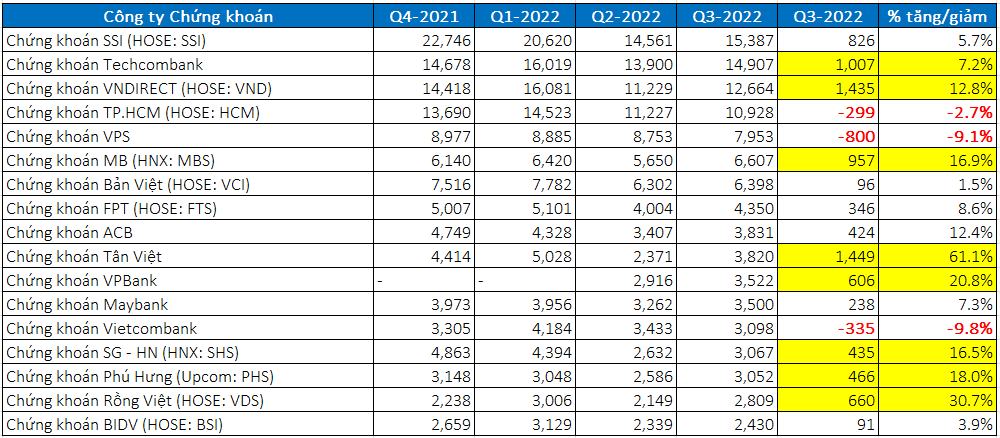
Although many cautious securities companies have reduced their loan portfolio with sensitive codes, however, the risk appetite of the companies is different. There will still be units that accept loans for risky deals at high prices.
According to DSC expert, the securities company’s margin channel is currently acting as a shock absorber for the process of reducing active/or compulsory leverage of the business. So will this process shift risk from the bond market to the margin channel? And when will there be a wave of corporate-level margin calls in the stock market?
Mr. Huy believes that there is no basis for these and that the 1,000 mark will play an important role. As long as retail investors calm down, the market will soon balance. Because the margin of this group is low, now no one is forcing to sell but only because of psychological factors.
According to the expert’s assessment, the impact of the bond channel on systemic risk is at a medium low level. However, if there is a case of systematic risk, a large margin call will be strong.
In the short term, experts still expect the 1,000 point mark to be maintained. Macro is not the deciding factor for the market next 1-2 weeks but the money flow story. Therefore, at this time, retail investors should still be cautious and risk management should still be on top.
Ha Anh/Market life