- Welcome to Pacific Bridge Capital
- Tel: 024.3516.1111
- Fax: 024.3684.1111
- info@pacificcapital.vn

How do inflation and exchange rate affect the valuation of stocks of steel, fertilizer, and construction materials?

International aviation is forecasted to grow strongly in 2023, aviation stocks are about to “take off”?
26/10/2022
Steel businesses race to report losses, thousands of billion dong “cover mats” in the warehouse
27/10/2022According to Yuanta, the currencies of other exporting countries are expected to continue to depreciate strongly against the VND, which will still put competitive pressure on prices on Vietnam’s exports.
Exports under pressure from inflation and exchange rate
Exports began to slow down from March 2022, when inflation started to pick up, although still growing year-on-year. Exports in August increased sharply mainly due to the reopening of China. Imports also witnessed a slowdown, especially from July until now.
According to Yuanta Securities, inflation in export markets caused purchasing power to decrease. In addition, the CPI of these countries is mostly higher than that of Vietnam, which puts pressure on the currencies of these countries to reduce their purchasing power against VND.
In terms of exchange rate, VND is among the top currencies keeping prices stable. Almost only USD increased in value compared to VND, but compared to high inflation of 8.3%, purchasing power in the US market still decreased.
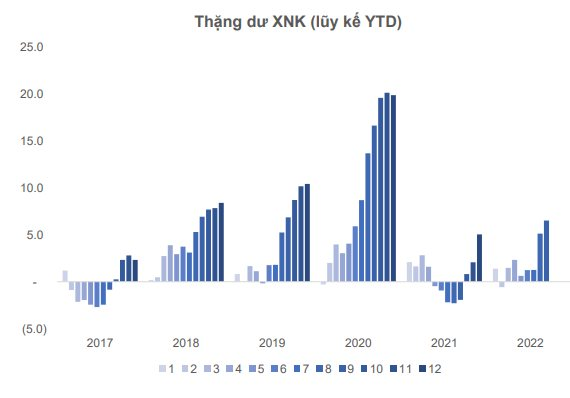
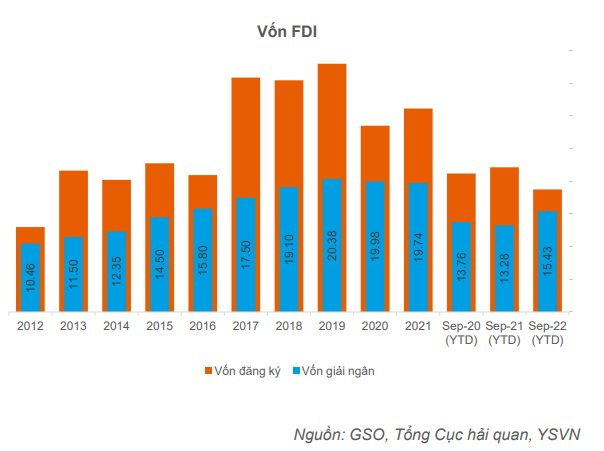
The analyst team believes that there are still many pressures to cause VND to depreciate against USD such as (1) foreign currency revenue from import and export in the first 9 months is quite weak compared to 2018 – 2020. (2) Registered FDI capital The decline in the number of transactions reduced the prospect of foreign currency revenue, although disbursed capital was still positive. (3) The obligation to pay international public debt in the first 9 months of the year is higher than the whole year of 2021, increasing the pressure on USD demand.
However, the Government still maintains the stance of exchange rate stability. Since the beginning of the year, it is estimated that the State Bank has sold more than 21 billion USD to ensure the supply of foreign currency. This helps stabilize the exchange rate – macro but puts pressure on exports.
The view of the State Bank is to continue to maintain macro stability and avoid macro shocks. Accordingly, if the USD continues to appreciate, the USD/VND exchange rate is still likely to increase, but the SBV will take measures so that the growth rate is not too strong. The scenario of USD/VND surpassing 24,000 is possible however Yuanta expects it will not exceed 24,300 in 2023.
Accordingly, the currencies of other exporting countries are expected to continue to depreciate strongly against VND, which will still put competitive pressure on prices on Vietnam’s exports.
How to value export stocks?
In terms of stock market in general, VN-Index has dropped about 30% from the peak, is trading at P/E 11.x times, equivalent to E/P at 9.x%, just lower than October period. December 2012.
This interest rate is higher than CPI of 4.77% and higher than 3-month interbank interest rate of 0.55%. Accordingly, the current valuation is already quite low, Yuanta finds that when macro conditions improve and listed companies return to growth, the market is likely to recover due to E/ attractive P.
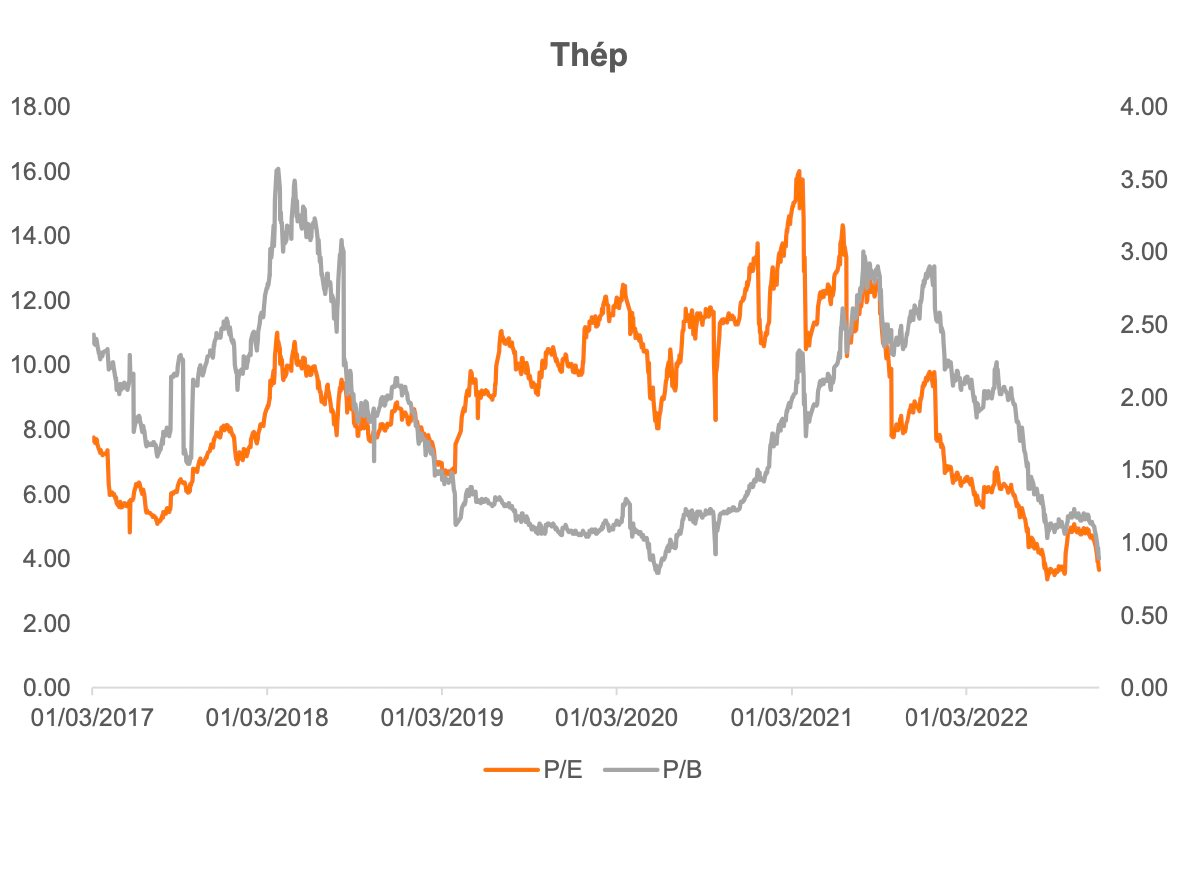
For steel stocks , the Yuanta analysis team believes that the export share of total steel production is not too much. However, the current P/B valuation of steel stocks is at a low level near the peak of Covid 2020.
The group of agricultural and seafood stocks has a valuation that is still not too low in terms of both P/E and P/B compared to history.
In the group of building materials stocks , the export proportion of construction material stocks listed on the floor is not too large. However, the current valuation of this group of stocks is still not close to the historical low.
The group of stocks that export wood and wooden furniture, althoughHowever, the current valuation is not low due to declining business results. The current P/B valuation of 0.89x is not too low but is close to the previous low (0.67x).
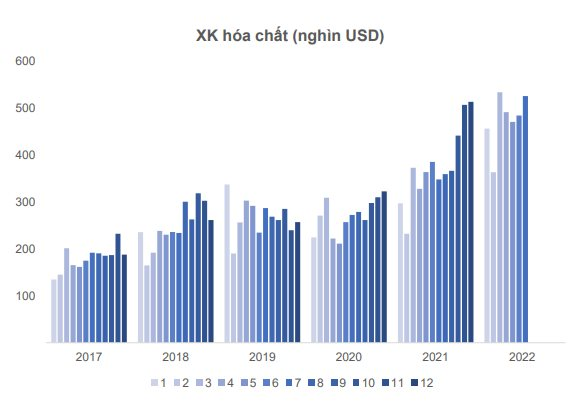
Chemical stocks , with positive business results and low P/E valuation, the current P/B (1.5x) is close to 2018 level (1.27x) which is not too high. Investors can consider individual chemical stocks with the potential for prices to continue to be high next year.
Textile stocks, P/E is currently quite low (7.35x), quite close to historical low (6.22x). Accordingly, investors can consider businesses that continue to have good export orders.
Plastic, rubber & fiber group : Despite good export results, the current P/E valuation is back to the level of 2020 (though still higher than 2018-2019). Therefore, investors can keep an eye on this group thanks to the support because oil prices are still high.
In conclusion, the Yuanta analysis team believes that investors can monitor/review several groups:
Exports decline, watch until the negative situation is reflected in stock prices and the situation improves: Iron and steel, wood and wooden furniture.
Exports remained good/less negative but stock prices fell in line with the general market such as fertilizers and chemicals.
Ha Anh/Market life