- Welcome to Pacific Bridge Capital
- Tel: 024.3516.1111
- Fax: 024.3684.1111
- info@pacificcapital.vn

Agriseco: Inflation of 5-10% will bring the highest profitability for VN-Index

VN-Index reversed course and gained nearly 7 points at the beginning of the week, foreign investors net bought nearly 600 billion dong
10/10/2022
‘Showers after drought’, VN-Index rebounded by nearly 29 points, foreign investors boosted their net buying of nearly 1,300 billion dong in the whole market.
12/10/2022The view of Agriseco Research is that in a moderate inflation environment, the stock market is still an appropriate investment channel when GDP growth is forecasted to continue at a high level.
Vietnam’s stock market is facing strong downward pressure in terms of both liquidity and score recently. Since the beginning of September, VN-Index has lost 19%, a total loss of more than 30% since the beginning of the year and is on track to retest the 1,000-point support level. In terms of valuation, the market is at an attractive price zone compared to history and many long-term investment opportunities are opened. However, at this stage, many uncertain macro factors are taking place, pushing up market risks.
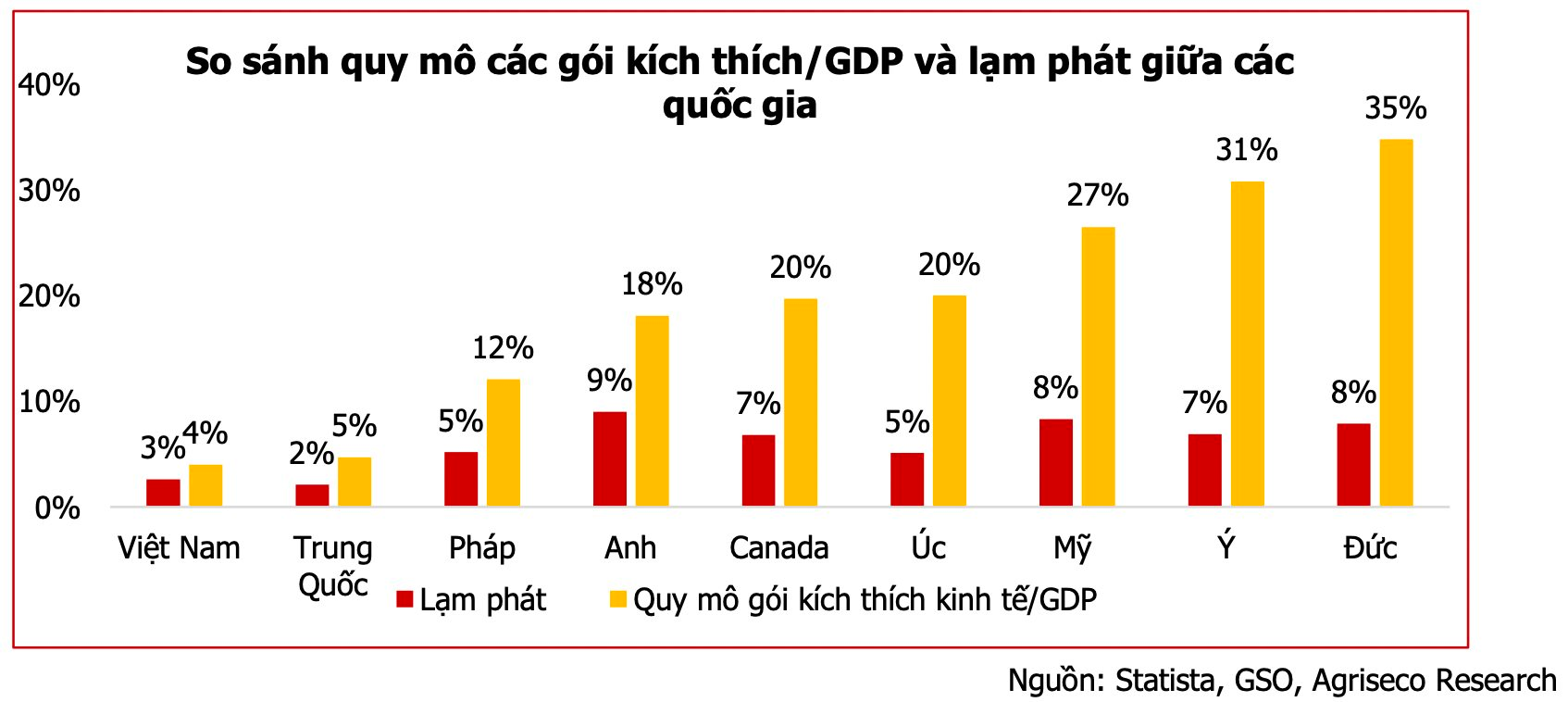
In the newly updated report, Agribank Securities (Agriseco Research) assessed that inflation will be one of the factors investors need to pay attention to. Currently, inflation is happening in most countries around the world. However, the increase in inflation in each country is different when the figures in Western countries such as the US and EU increase higher than in Asia.
For Vietnam, Agriseco Research believes that inflation is still under control, although the pressure is gradually increasing. The data shows that Vietnam is still one of the countries with low inflation in the region when the CPI in September only increased by 3.94% over the same period and the average in the first 9 months of 2022 increased by 2.73% compared to the same period last year. with the same period.javascript:void(0)
In this year 2022, inflation is expected to reach the target set by the National Assembly (below 4%), however, in the last months of the year, Agriseco believes that inflation pressure will be high mainly due to the double impact of expenditure factors. push and pull charges. Vietnam has a large economic openness to international trade with a trade value equal to 200% of GDP, so when external factors change, it will affect the price of input materials. Furthermore, the increased demand for production of goods and services due to the impact of the recovery program will also increase commodity prices.
Agriseco Research: Statistics show that inflation below 10% is not a cause for concern and the stock market can still grow
Regarding the impact of inflation, many world and Vietnam studies also show the relationship between inflation and economic growth. Inflation at different levels will have different effects on economic growth, and inflation does not always have a negative impact on the economy. For emerging and marginal markets like Vietnam, a moderate inflation rate of 5% – 10% will lead to economic growth, improved consumer demand, and growth in trade activities. If inflation rises too high, it will have the effects of increasing prices of many goods and will lead to an increase in interest rates and a decrease in consumer purchasing power, thereby causing an economic recession. In fact, in the period 2008-2009, due to the impact of the world financial crisis, Vietnam’s inflation increased by an average of over 20%, the interest rate was also over 20%, causing many businesses to stop operating, the economy fell into recession. difficult.
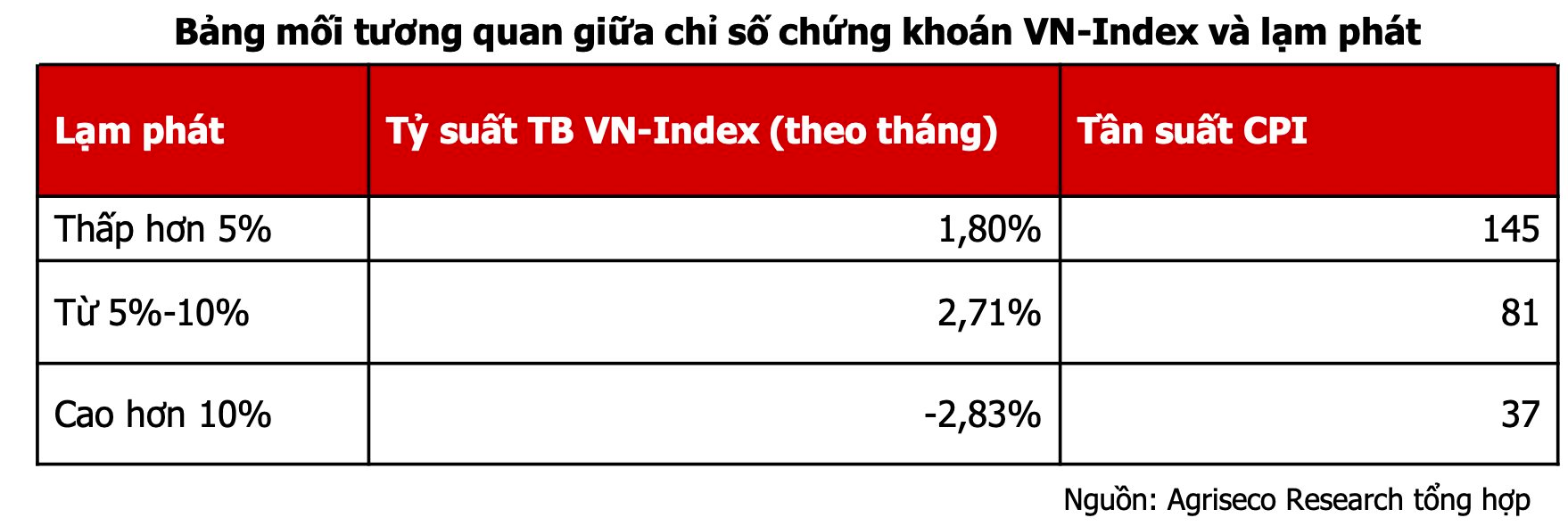
In particular, inflation and the stock market are correlated to different degrees. According to statistics of Agriseco Research, inflation below 10% is still not a cause for concern and the stock market can still grow, specifically, inflation of 5-10% will bring the highest profitability ratio for VN-Index. .
Agriseco’s statistics show that, since the stock market started operating in 2000, Vietnam’s economy has spent 81 months with a CPI of 5-10%, in these months the VN-Index has grown on average. 2.71%/month, the highest level compared to other levels of inflation. However, it is very dangerous if inflation exceeds 10%. When inflation accelerates to above the double-digit region, stocks often plummet and cause great damage to investors. Statistics show that VN-Index has spent 37 months with an inflation rate higher than 10%. The market rate in this period decreased to 2.83%/month. More specifically, there are months with a very strong decrease of over 20%/month like the months in the period 2008-2009.
Which stocks should increase their weight in the context of moderate inflation and high GDP growth?
Regarding investment strategy, the view of Agriseco Research is that in a moderate inflation environment, the stock market is still an appropriate investment channel when GDP growth is forecasted to continue at a high level.
In particular, a number of industries will benefit from rising commodity prices . When inflation escalates, commodity prices often rise sharply, especially for basic goods. According to Agriseco, it is reasonable to invest in a group of businesses that are manufacturing and trading in commodities with the expectation of price appreciation in an inflationary environment when investing in derivatives is still not suitable for the majority of investors. . Besides, when the price of raw materials increases, businesses with closed production and business chains will benefit from the increase in output prices.
In addition, in a period of high inflation and raw material prices, enterprises that are self-sufficient in input will help improve profit margins. The level of benefit will be greater for businesses that have the ability to control output prices or highly competitive products. Accordingly, groups of businesses that produce and supply goods themselves benefiting from geopolitical events will be notable groups. These groups of businesses, when they have completed the value chain, will be less affected by inflation and are very suitable for medium and long-term investment.
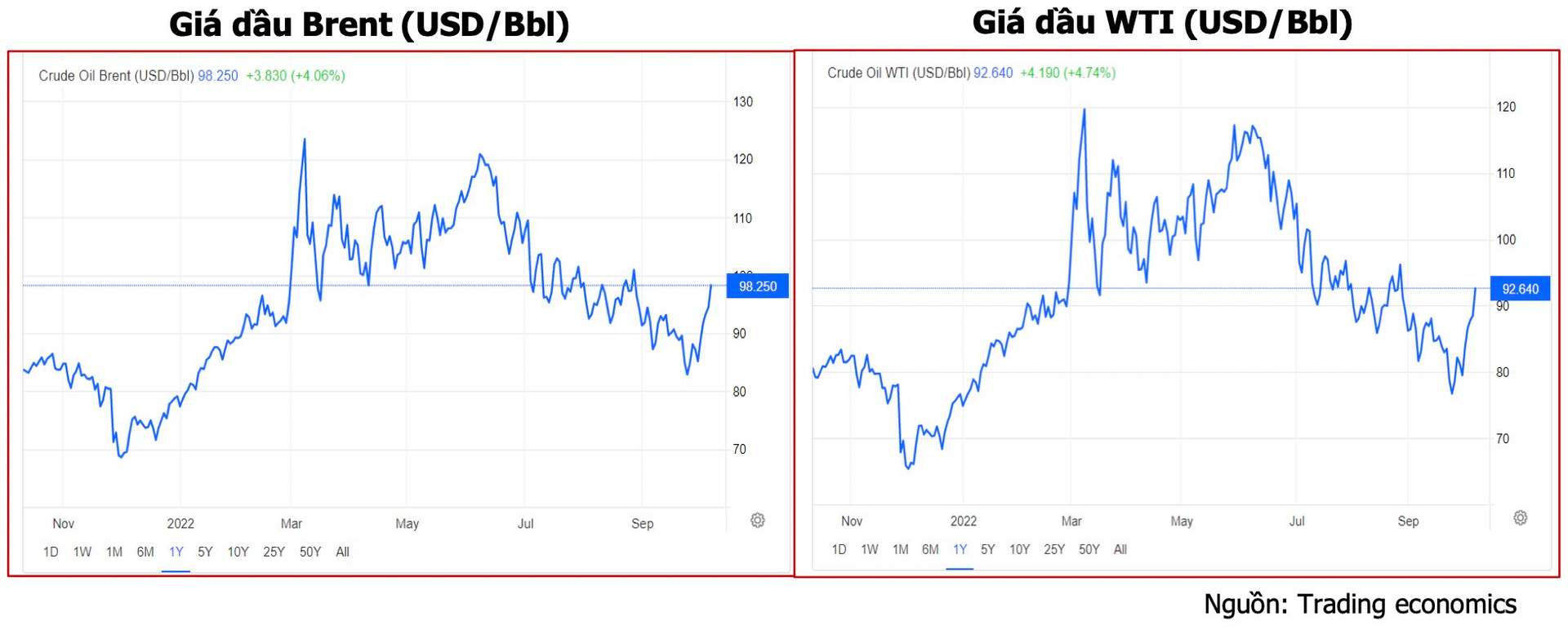
Meanwhile, the price of Brent oil has continuously increased by more than 50% and gas prices in Europe have also increased by more than 90% since the beginning of the year. Agriseco Research believes that maintaining the high price of oil at a high price of 80-100 USD/barrel can help the business results of oil and gas enterprises to improve well when most of them set business plans based on the scenario. Oil price is about 60-70 USD/barrel this year. Therefore, the report recommends that investors who have disbursed stocks continue to hold oil and gas stocks and closely monitor geopolitical developments to take appropriate actions.
On the other hand, the agriculture and food industries are characterized by necessities, safety and often have more profit from high dividends, so they are also the industry groups to invest in during the inflation period. Input costs of enterprises in these industries often increase more slowly than output prices, so profit margins will be improved. Besides, the conflict between Russia and Ukraine will affect the supply and push up global food prices, leading to Vietnamese rice exporters can benefit when the price of rice will also increase. world food, along with export demand will increase to become a substitute for wheat or corn. Investors should choose businesses that own a closed production cycle chain, helping to better control costs.
At the same time, it is impossible not to mention the group of insurance companies. In an environment of high inflation, business results of insurance companies are usually better thanks to increased demand for insurance. Besides, thanks to the high proportion of deposits of insurance companies, these businesses will benefit when the interest rate increases. In particular, for life insurance companies, an increase in technical interest rates (interest rates on government bonds with a term of more than 10 years) will help reduce the cost of making mathematical provisions on newly signed contracts. That helps to improve profitability and increase equity.
In addition, defensive essential industries such as Electricity, Water, Pharmaceuticals, Technology will have stable demand, not be reduced by purchasing power due to high inflation, which will be a safe destination. Technology group is an investment trend in the future with the 4.0 technology revolution, the remaining industry groups have quite reasonable valuations, regular annual dividends and will be suitable for accumulation at different stages. market decline.
In contrast, Agriseco Research also recommends that stocks with high debt ratio, businesses that have not completed value chains and have weak competitiveness, and speculative stocks should be downgraded in the current context. .
Phuong Linh/Market Lifestyle