- Welcome to Pacific Bridge Capital
- Tel: 024.3516.1111
- Fax: 024.3684.1111
- info@pacificcapital.vn

Rice industry “widespread” new sugar, wading upstream in the wave of stock market price decline

Vietnam’s stock market usually falls immediately when interest rates rise, but will recover in the 3rd month with bottom-fishing cash flow entering.
26/09/2022
Becamex and Warburg Pincus as cross-border e-commerce hubs
29/09/2022Going upstream, rice businesses became the focus of cash flow, especially LTG (Loc Troi), TAR (Trung An), AFX (An Giang Import-Export) and PAN (PANFood) maintained good momentum. regardless of the common market.
The first trading session of the week on September 26, 2022 continued to witness a sharp decrease. At the beginning of the session, VN-Index dropped more than 16 points, most stocks were under general pressure.
Going upstream, rice businesses became the focus of cash flow, especially LTG (Loc Troi), TAR (Trung An), AFX (An Giang Import-Export) and PAN (PANFood) maintained good momentum. regardless of the common market.
The price of rice has been and will continue to increase
It is known that rice stocks have recently been interested in the context of “favorable weather”. In particular, the price of rice is increasing because India restricts rice exports. India exports rice to more than 150 countries and contributes about 36.7% of the global rice trade, so any drop in export volume will put pressure on rice prices.
On the other hand, the global rice supply still faces risks due to severe weather conditions in major exporting countries, as noted in the latest report of VNDirect Securities (VND).
Specifically, recent extreme weather in Asia’s top rice exporting countries, which account for about 90% of world rice production, is likely to reduce yields and output this year.
China alone, the world’s largest rice consumer, has suffered severe drought in seven provinces, causing the country’s rice production to be reduced and is expected to increase rice imports to a record level. is about 6 million tons in crop year 2022/2023.
According to the US Department of Agriculture, global inventories have fallen to a 4-year low when forecasting the inventory/consumption ratio for the period 2022-2023 (inventory-to-consumption ratio) at just 34 .4% (compared to the average of 36.6% for the period 2018-2022).
Meanwhile, VND sees increasing demand. China is expected to increase rice imports to a record 6 million tons in 2022/2023 due to reduced yields. Not to mention, the ban on food exports including wheat and sugar from India, palm oil from Indonesia and other food importers like the Philippines are trying to increase their inventories.
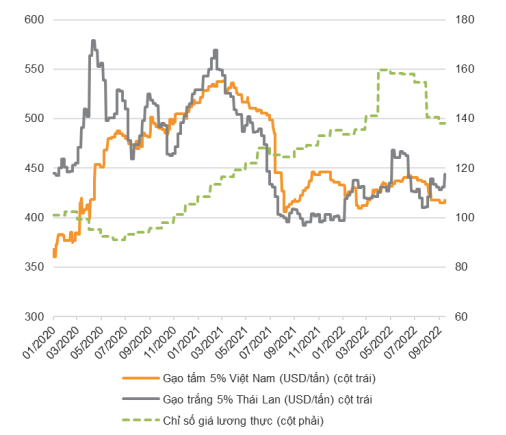
Therefore, VND believes that rice may be under pressure to increase prices in the near future. And in that, Vietnam is in a good position to catch the rising price of rice. The Thai government is also looking for solutions to support farmers in the context of high input prices, including a strategy of shaking hands with major rice exporting countries (including Vietnam) to raise prices. sell.
Rice prices in Vietnam and Thailand (USD/ton)
Source: Synthesized VND.
Vietnam is the world’s third largest rice exporter, after India and Thailand, with 7.8% of global trade; and is the largest exporter to China with 24.5% market share. Indian rice prices are in a weaker competitive position due to higher tariffs, which in turn pushes buyers to shift to Thai and Vietnamese rice.
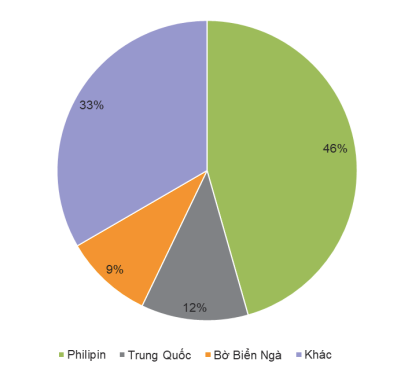
In the first eight months of 2022, Vietnam’s rice export value and output reached 2.3 billion USD respectively – up 9.9% over the same period and 4.8 million tons – up 20.7%. China is Vietnam’s second largest rice export market, after the Philippines, accounting for 12% of total rice exports in the first eight months of 2022.
Recently, the Prime Minister has directed the Ministry of Agriculture and Rural Development to develop a project on sustainable production of 1 million hectares of high-quality specialized rice, reducing greenhouse gas emissions in the Mekong Delta region. Mekong Delta). Accordingly, in order to improve the quality of exported rice to meet international standards, the Market-oriented Smallholder Rice Value Chain (MSVC) project was born, under the public-private partnership between Olam Company. Agri, the German Organization for International Cooperation (GIZ) and the Ministry of Agriculture & Rural Development.
Proportion of Vietnam’s rice export markets in the first 8 months of 2022
Source: Synthesized VND.
Enterprises with a large proportion of exports such as TAR, LTG, and PAN will benefit
With the above points, businesses are taking advantage of the industry’s general opportunities; especially the group of companies with a large export weight of rice such as TAR, LTG, PAN.
In particular, LTG will directly benefit from rice exports thanks to being one of the rice distributors to both major markets at this time, Europe and China. With the development orientation focusing on the food segment, the revenue proportion of the rice segment will reach 39% in 2021 (2020: 28%) and 57% in the first 6 months of 2022. Although the gross profit margin of the segment is low. (2-3%), VND believes that this will be improved by higher export prices. We expect the increase in export rice output will lead to contracts with farmers and expansion of raw material areas. Thereby, it will boost the revenue of the pesticide segment as well as the plant variety segment of LTG.
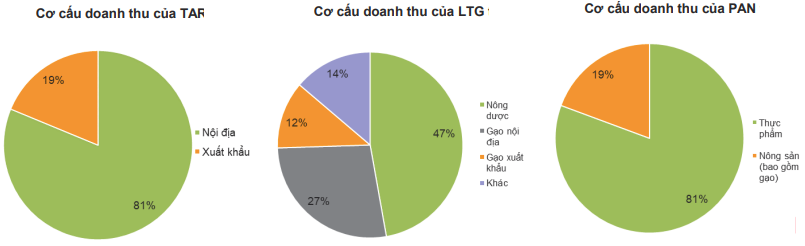
With TAR, the Company expects to benefit from China’s production reduction and India’s export restriction due to drought. Rice trading is TAR’s main business, with exports accounting for nearly 15% of total revenue.
In which, China is the main rice export market of this enterprise with a proportion of up to 27% of export revenue. Therefore, VND expects China to increase rice imports from Vietnam, which will be the driving force for TAR to increase export output. Moreover, an increase in export rice prices is expected to help improve gross profit margin in this market, which is considered to have a low profit margin compared to the European market.
Finally, the PAN will also benefit directly from Europe’s reduced production and India’s export restrictions due to drought. When, the agricultural segment has now become one of PAN’s key industries when contributing 19% to total revenue and 39% to total gross profit. The decline in European rice production will be a factor helping to boost exports. In addition, the increase in export price of rice is expected to help increase the gross profit margin of the rice segment.
Export share of TAR, LTG and PAN in 2021
Tri Tuc/Market life