- Welcome to Pacific Bridge Capital
- Tel: 024.3516.1111
- Fax: 024.3684.1111
- info@pacificcapital.vn

Not only ETFs, there is a “footprint” of a group of foreign investors who are quietly pouring money into Vietnamese stocks

Real estate stocks recovered from the bottom, Dragon Capital net bought KBC, GEX and returned to the role of major shareholder
02/12/2022
Liquidity increased slightly, VN-Index reversed and broke through nearly 10 points
08/12/2022ETFs accounted for more than 30% of the total value of foreign net buying in matching orders. So where did the rest of the net buying of foreign investors come from?
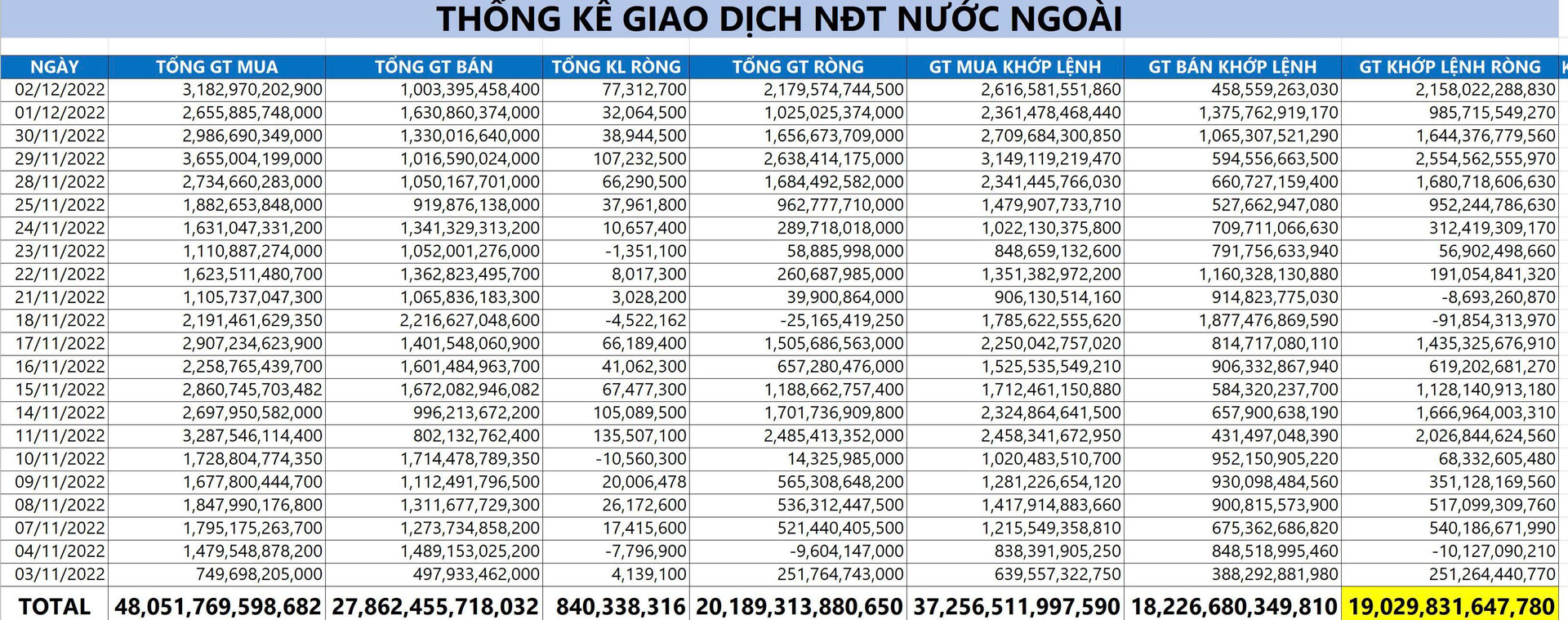
After ups and downs, VN-Index has had a spectacular “revival” since the bottom. One of the factors contributing to the uptrend of the market recently was the return of foreign investors. The net buying of foreign investors started from November 3, and from that time to December 2, the net buying value amounted to more than 19,000 billion dong.
Only in the first week of December (from November 28 to December 2), foreign investors net bought 7,908 billion dong, of which the strongest net bought stocks HPG (1,435 billion), VHM (1,308 billion), STB (801 billion), SSI (559 billion), VIC (685 billion), MSN (564 billion), CTG (354 billion), KBC (280 billion), KDH, (305 billion), VND (243 billion), VNM (243 billion), VRE (226 billion), VCB (256 billion), GEX (195 billion).
Out of the total net buying value of more than 19,000 billion dong of foreign investors, there were contributions from foreign ETFs, most of which are Fubon ETFs, about 4,500 billion VND, internal ETFs about 1,100 billion VND. It can be seen that ETFs account for more than 30% of the total value of foreign net buying and matching orders. So where did the rest of the net buying of foreign investors come from?
The “footprint” of a group of foreign investors on the stock market
Huynh Minh Tuan – Founder of FIDT Joint Stock Company analyzed that the size of the Fubon FTSE Vietnam ETF portfolio reached approximately NT$20 billion, equivalent to more than VND15,900 billion. This is an ETF that closely follows the FTSE Vietnam 30 index and has disbursed most of the above amount, so the scale of foreign net buying in the past week shows that there is a “footprint” of another group of foreign investors.
It is a type of derivative financial instrument called Participatory Notes or P-Notes, which are issued exclusively by foreign investors by investment institutions.
In order to issue P-Notes, large financial institutions usually accumulate a sufficiently large number of shares, including large, liquid, efficient and representative stocks of the market. into a directory. On top of that portfolio, these financial institutions will issue P-Notes to foreign investors interested in investing in the stock market of the host country.
In the Vietnam stock market, all four large foreign investment banks, namely Deutsche Bank, HSBC, Citigroup and Merrill Lynch (now a part of Bank of America) have issued P-Notes for customers. their own abroad.
P-Notes is especially attractive to investors thanks to its characteristics that are both a fund certificate (CCQ) and a payment instrument similar to commercial paper. Accordingly, the owner of P-Notes does not need to register information with the management agency and still fully enjoys the right to receive dividends and capital gains from the investment securities portfolio.
Therefore, this is an unpredictable and fast cash flow, so it will significantly affect the market’s movements in the short term and is often considered highly speculative. The risks of P – Notes are unpredictable fluctuations, capital flows of unknown origin and potential big risks.
“With the mechanism mainly focusing on large-cap and liquid stocks, which had a strong influence on the indexes at the time of purchase, some stocks were strongly net bought by foreign investors in the past time such as HPG, VIC, VHM. , MSN, CTG, VRE are almost certainly in the list of P – Notes”, predicted Mr. Huynh Minh Tuan.
Look to the past to see the present and predict the future
Looking back at the past, after the financial crisis in 2008 caused the VN-Index to fall from nearly 1,180 points to 235 points, and in 2009 was a period of strong money injection pushing the index from 235 points to 632 points and then falling again. about 427 points at the end of 2009. That was the time when cash flow from P – Notes first landed in Vietnam stock market.
Large-cap stocks bought strongly by P – Notes at that time were HPG, VIC, BVH, HAG, VNM, VCB, PVD, MSN. The stocks with the strongest increase in this period can be mentioned as HPG increased by 3.5 times, BVH increased by 5 times, VIC increased by 10 times,…
In the last period from 2009 to 2010, foreign investors were net buyers for 15 consecutive months. In 2010 alone, foreign investors net bought 15,250 billion dong. At that time, ETFs only contributed more than 3,000 billion dong of the total 15,250 billion dong of foreign investors’ net buying in 2010. Thus, the anonymous net buying part was the “footprint” of P – Notes.
It can be seen that although the index did not increase much in 2010, the stocks bought by P – Notes all increased strongly in 2010 and the liquidity in this period was almost double compared to the previous one.
The next possible period for P – Notes is 2016, which is a buy-only and almost no-sell phase. Another recent period that is also quite clear with the appearance of P – Notes is from the end of 2018 to March 2019.
Cash flow prediction feature P – Notes
The unmistakable identifying feature of P – Notes’ trading is a very strong attack, the stocks are almost straight without any correction and there is almost no chance for slow investors to buying. In addition, the capital flow of P – Notes is extremely speculative, entering very quickly and exiting very quickly, so it is extremely fierce when it sells out.
The market liquidity is usually when P – Notes in increases so much that many people think it is liquidity in an uptrend. Another feature is that P – Notes often comes in at times when the market looks very weak, liquidity is flat or after a period of strong decline.
The context is quite similar when at the end of October 2010, VCB lowered the lending interest rate and at the end of November 2022, VCB also reduced the lending interest rate to 1%. Regarding the trading time, looking at the past chart of VN-Index and codes like HPG, VIC, VHM,… we can see that P – Notes usually buy very strongly in the last months of the year or the first months of the year. Although difficult to predict accurately, the strongest buying period of P – Notes usually lasts about 1.5-2 months.
“Currently, this capital flow may have been somewhere for about 2 weeks and it is subjectively predicted that this capital flow will continue until the middle or end of December”, Mr. Huynh Minh Tuan assessed.
Ha Anh/Market life